EN
EN

What is the role of laser technology in anti-counterfeiting foil development?
2026/09/11
See how UV and femtosecond lasers write covert codes into anti-counterfeiting foils, plus CO2 demetallization limits and real-time process control.
2026/07/31
2026/07/31
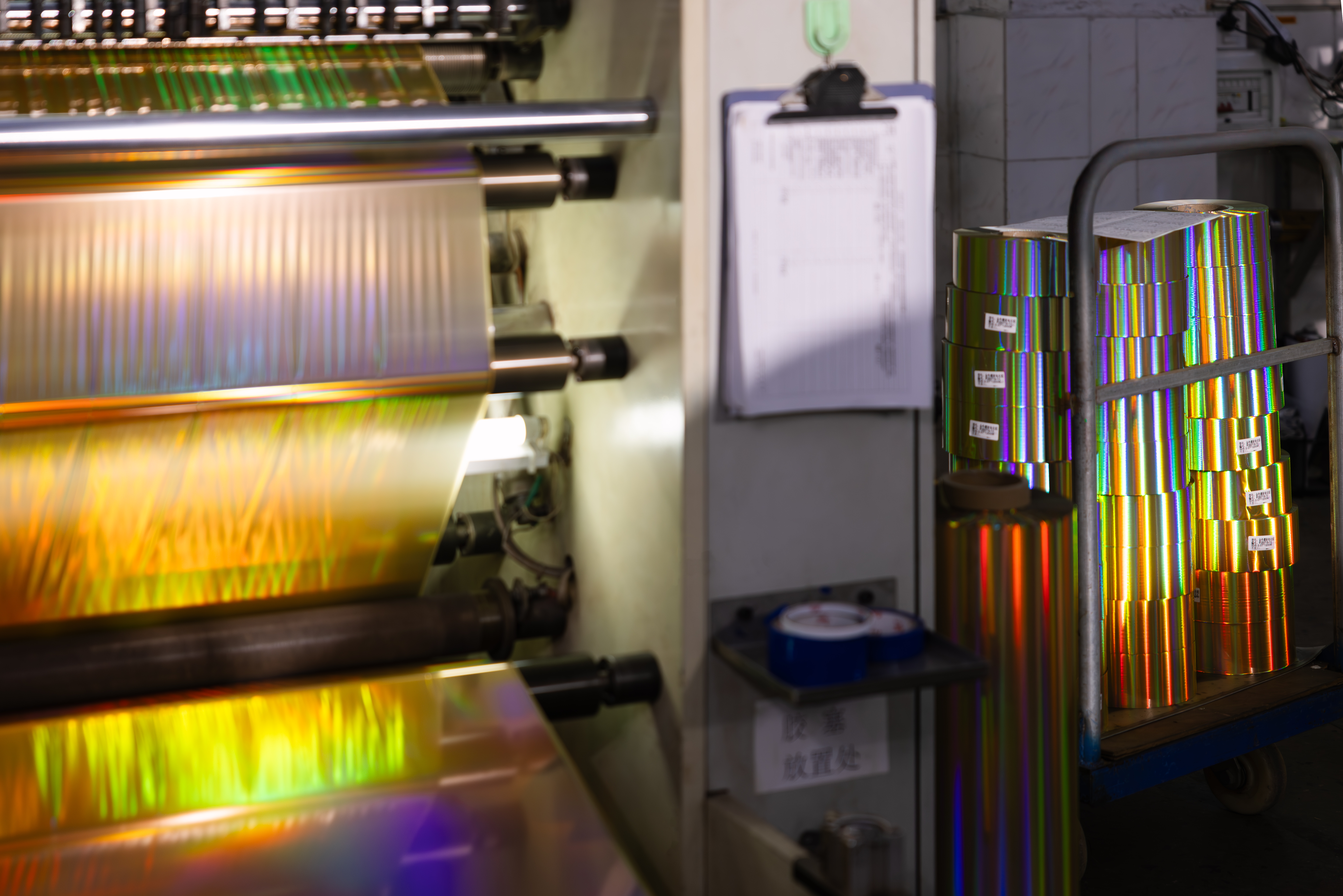
The manufacturing workflow begins with creating a master holographic plate that carries the required optical pattern. The plate is then used to form the imaging structure on the coated film. Pattern quality depends on artwork preparation, plate accuracy, embossing control, metallization, coating consistency, and final inspection.
Even tiny inaccuracies during this high-precision optical recording process will negatively impact overall foil quality and visual consistency.
Minor deviations in laser calibration and alignment can severely compromise the finished optical quality of holographic foils. Misaligned laser beams will create uneven micro-prism depths and irregular grating structures on the master plate, resulting in patchy, inconsistent rainbow reflection and defective optical performance on final foil products. Such subtle optical errors lead to unqualified pre-production samples that cannot meet mass production standards. For this reason, professional manufacturing environments adopt high-precision vibration isolation and laser calibration systems to eliminate micro-shake distortion and ensure uniform, accurate micro-grating patterns during laser optical recording.
After the master plate is confirmed, continuous roll coating builds the functional structure on a PET carrier film. The release, imaging, metallization, and adhesive layers are designed to work together for stable hot stamping and transfer performance:
1. Release layer: A thermoset resin coating designed to cleanly separate holographic graphics from the base film during the hot stamping process.
2. Holographic imaging layer: A tailored thermoplastic coating that accurately receives and retains micro-grating embossing patterns transferred from precision master plates.
3. Vacuum metallizing carrier layer: A smooth, high-uniformity intermediate coating that ensures even aluminum vapor deposition for consistent optical reflectivity.
4. Heat-activated adhesive layer: An adhesive system formulated to support stable foil transfer onto compatible paper and selected plastic substrates.
All functional layers are produced under strictly calibrated coating thickness and professional oven drying thermal regimes to prevent coating cracking, insufficient curing, and structural defects. Inconsistent layer control can contribute to delamination, peeling, or incomplete transfer during downstream printing and packaging production. Consistent coating control and process monitoring help reduce these risks.All functional layers are produced under strictly calibrated coating thickness and professional oven drying thermal regimes to prevent coating cracking, insufficient curing, and structural defects. Inconsistent layer control can contribute to delamination, peeling, or incomplete transfer during downstream printing and packaging production. Consistent coating control and process monitoring help reduce these risks.
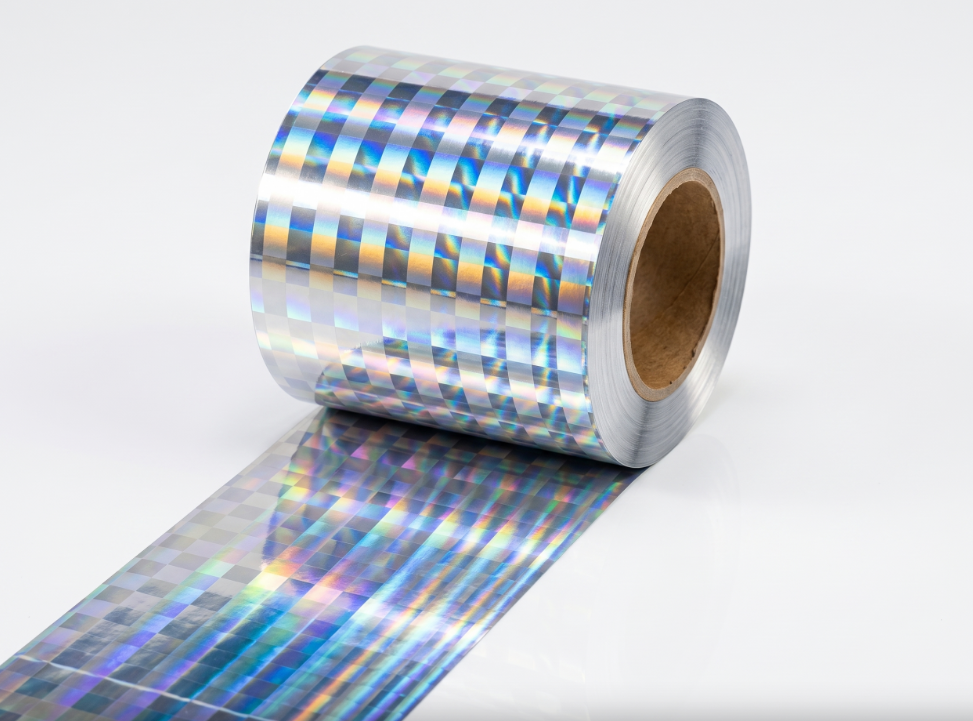
Embossing serves as the core procedure for embedding invisible holographic patterns into the imaging layer. Heated precision metal master rollers transfer intricate micro-diffraction structures onto the thermoplastic imaging layer under finely tuned temperature and pressure conditions. Controlled industrial embossing transfers the required diffraction structure with consistent pattern definition and production stability for customized holographic foils.
Premium embossing equipment enables drastically refined micro-pattern definition, forming a core competitive edge for holographic foil embedded with hidden micro-text anti-counterfeit features. Consistent film tension control throughout full-width embossing operations is essential. Improper tension, whether overly loose or excessively tight, will trigger pattern stretching and structural distortion, compromising the integrity of finished holographic textures.
Once embossing completes, coated film enters a sealed high-vacuum chamber for aluminum vapor deposition, the critical procedure that generates vivid rainbow iridescent effects on holographic foil . In a strictly controlled high-vacuum environment, high-purity aluminum ingots melt and vaporize, then evenly condense into an ultra-thin metallic layer covering the entire embossed imaging surface.
This vacuum metallization process is indispensable for holographic visual performance. Without complete and uniform aluminum coating, the engraved micro-gratings fail to reflect full-spectrum light, resulting in faint, dull, low-contrast patterns with no vibrant rainbow luster. The metallization running speed is precisely synchronized with embossing production efficiency to avoid inconsistent metallic layer thickness, which effectively prevents bright and dark strip defects on finished foil rolls. The metallized layer is designed to provide consistent reflectivity while balancing optical performance and practical packaging requirements.
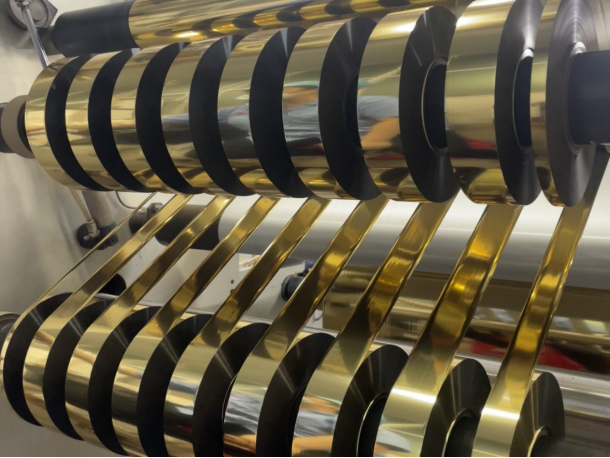
Metallized wide-format film proceeds to professional post-processing slitting, where full-width master rolls are precisely cut into customized widths to meet diverse customer application requirements. All finished foil rolls undergo documented quality-control inspections covering appearance, release, adhesion, and transfer performance against applicable production requirements. The quality inspection system covers four core indicators: consistent holographic brightness across the entire roll, stable adhesion strength adaptable for multiple substrates, clean and smooth release layer separation, and flawless metallized surfaces free of scratches and blemishes.Metallized wide-format film proceeds to professional post-processing slitting, where full-width master rolls are precisely cut into customized widths to meet diverse customer application requirements. All finished foil rolls undergo documented quality-control inspections covering appearance, release, adhesion, and transfer performance against applicable production requirements. The quality inspection system covers four core indicators: consistent holographic brightness across the entire roll, stable adhesion strength adaptable for multiple substrates, clean and smooth release layer separation, and flawless metallized surfaces free of scratches and blemishes.
Sections with problematic grating refraction effects or insufficient aluminum layer adhesion are fully marked and completely trimmed before final rolling and packaging. In addition, professional stamping tests on paper and PP plastic substrate samples are conducted with trial foil strips to verify stable transfer performance. This rigorous pre-packaging inspection mechanism effectively eliminates potential batch quality risks and ensures stable, reliable product performance for brand packaging manufacturers.
Holographic foil manufacturing carries inherent technical limits that designers and converters need to account for before ordering custom runs. Two notable constraints restrict broad application flexibility:
1. Ultra-fine intricate graphic lines cannot be perfectly replicated during master plate laser recording, requiring reasonable structural optimization for ultra-fine micro-text anti-counterfeit patterns to ensure stable embossing and presentation effects.
2. Some low-softening-temperature substrates require a carefully matched adhesive system and process window; suitability should be confirmed through sampling before production.
These technical boundaries do not hinder large-scale industrial application; instead, they guide scientific artwork adjustment and precise substrate matching in advance, greatly reducing trial-and-error costs and production waste.
Experienced holographic foil manufacturers combine pattern development, coating, embossing, metallization, slitting, and quality inspection. GL Foils uses its production and testing capabilities to evaluate coating, embossing, and transfer performance against customer artwork and compatible packaging substrates, supporting consistent customization and batch supply.
2026/09/11
See how UV and femtosecond lasers write covert codes into anti-counterfeiting foils, plus CO2 demetallization limits and real-time process control.
2026/09/11
Hologram foil uses electron beam lithography, kinematic holography, dot matrix diffraction, and nanofabrication for secure high-definition packaging.
2026/09/11
See how light shifts color and motion, adding secure visual effects that resist copying on printed cartons and retail labels for brands worldwide today.
2026/09/11
Security holograms and holographic labels add overt protection. Learn optics, foil, design, pitfalls, limits, and fake risks in real world use.
2026/09/11
Learn how metal decoration works without heated dies, plus substrate limits and inline setup costs, quality control and output plans for packaging lines.
2026/09/11
Hot stamping foil uses heated dies; metallic ink prints via a printing process. Compare brilliance, adhesion, rub resistance, cost, substrate for decoration